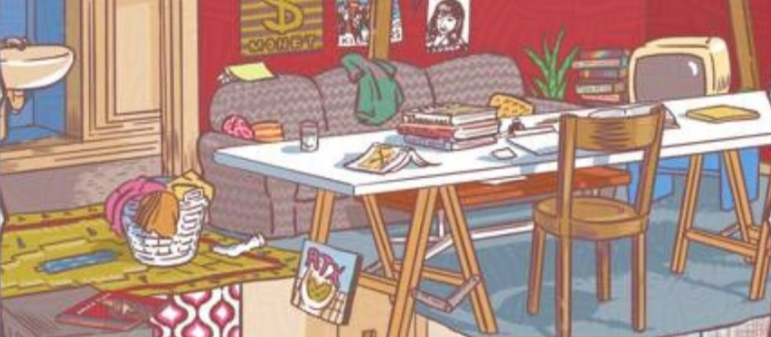
In 2023 I started Bright Light, Desert City. Until then, I had drawn short comic stories before. Usually, my mode of working is drawing in series, which means that the drawings I create about a subject, like subways, trains or cities have an underlying connection. They work as a standalone drawing, but when grouped, they create context. They amount to a loose, intuitive kind of story.
Creating a comic puts more constraints on continuity and storytelling. It also has some practical issues, like: how big or small is the text going to be? What will the text versus image ratio look like? What is the rhythm of the paneling?
There are challenges I still grapple with, now and then. Ideally I perfect the drawings before I release them. But with a comic, I decided to permit myself some freedom when it comes to publishing a page on my website. Not perfecting every little thing takes away some of the pressure. The result is that I create less hurdles for myself, while remaining critical of how the art comes out.
The story and associated visual imagination need to be built into a continuous flow. It has to be something that brings me joy when I work on it, as opposed to working against a deadline. I have worked with deadlines for years and I’m still getting used to not having to do so.
That said, the way I set up the drawings, the paneling and the way I want the story to unfold, that’s a road all unto itself. I make use of my experience as a professional illustrator here; it’s all about communication. I put myself in place of the reader, how will they interpret what I create? Is the subject matter presented in a way that is clear to someone who doesn’t know anything about the story?
I want to challenge myself when it some to designing the pages. I make use of my own visual language like the collage-like stuff I did for clients as well as in my personal projects. My drawings are often framed like a film scene.
In art school, when I thought too hard about what to create in given assignments, my work would invariably become forced.
This made me think about arts and crafts lessons in elementary school, where we had to learn to knit. The harder I tried knitting, the more rigid and tight my piece of knitted fabric became.
I can’t brute-force my way to an interesting concept. An important lesson too, for me, was that there’s always a process. Part of this process is to take a step back. I found this hard to do, since I have a tendency to hyperfocus. But it works. A walk, time away from the project often works in its favor. I talked to friends, classmates. And I found a better way.
Since I liked watching movies, I got the idea to look at subjects and scenes as a cameraman would. This way of observing gave me the freedom and headspace I needed to come up with interesting viewpoints.
I started watching movies, while having a sketchbook and pencil ready. This was the VHS era. Pausing the tape would hold for only eight minutes. After that, the tape would start up again automatically. This was a safety measure buit into VHS recorders, meant to protect the tape against being damaged. I would have eight minutes of sketching.
At this point I was in the fourth year of art school and as students, we were expected to think up and manage our own projects. We were also expected to schedule in feedback sessions with our teachers. So I would get out of bed in the morning, watch a part of a movie, while drawing film scenes. After about thirty minutes I would turn off the TV. I then started drawing from scratch, trying to think like a cameraman, imagining drawings as short moments, where part of the story is taking place just out of frame.
This approach has worked well for me. Through the years, I have worked on this method, finetuning it. But it is not dogma. It’s important to keep it open, to keep having fun with visual framing.
Bright Light, Desert City keeps me focused, entertained and busy all at once. I’m creating a world. It’s exciting and fun. I’m learning new stuff.
It can also be a bit of a slog sometimes. But that, too, is part of the process.